


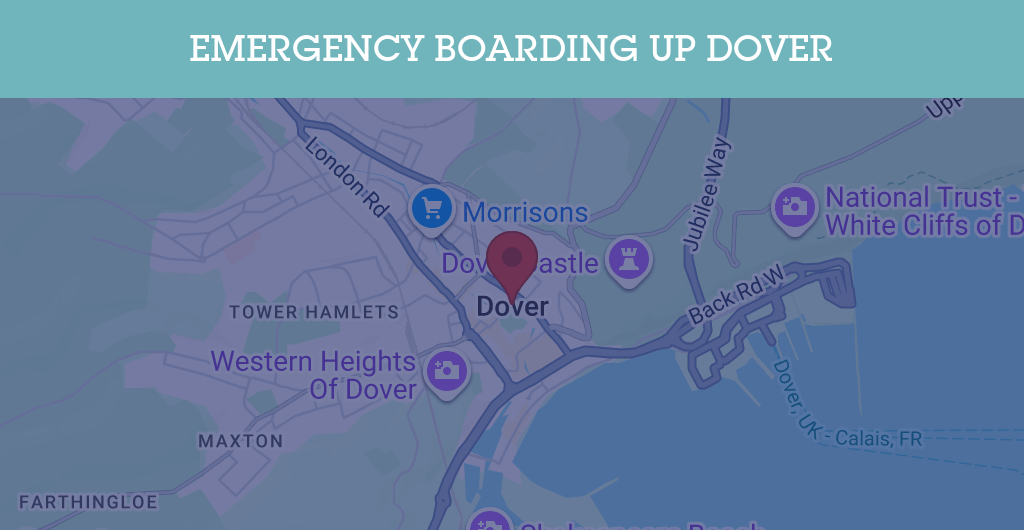
Boarding Up Dover (CT15) – Emergency & 24/7 Property Security
If you’ve just had a smashed window, a forced door, or a shopfront incident in Dover, the priority is simple: secure the property and make it safe before the damage leads to theft, weather ingress, or further vandalism. Boarding Up Canterbury provides 24/7 boarding up in Dover and across CT15, with additional coverage into CT16 and CT17 when you need urgent help.
We’ve been trading for 10+ years, we’re fully insured, and our technicians are DBS-checked. When you call, we’ll ask a few practical questions (what’s been damaged, whether there’s any risk to people, and whether the property is occupied) and then give you a realistic ETA based on workload and conditions. We don’t promise impossible arrival times—but we do prioritise urgent “make safe” jobs and aim to attend as quickly as possible.
Need help now? Call 01227 953 460 and tell us what’s happened in CT15.
Why boarding up matters in Dover (CT15)
Dover has a mix of residential streets, commercial premises and high-footfall areas where damage can happen quickly and unpredictably. In practice, “boarding up Dover” searches often come from people dealing with one of these local patterns:
- Busy routes and impact damage: Properties near main roads and junctions can see accidental impacts—wing mirrors, debris, or in rare cases a vehicle strike. Even a small break can become a big problem overnight if wind and rain get in.
- Shopfront vulnerability in active areas: Retail and takeaway fronts are glass-heavy by design. A single cracked pane can compromise the whole frontage, and a shopfront boarded up quickly can prevent a second attempt later the same night.
- Older windows and frames: Parts of Dover have older housing stock with timber frames and larger panes. When a sash or casement frame is already tired, a break can mean the glass and frame both need stabilising—not just covering.
- Seafront exposure and weather: Dover’s coastal position means wind-driven rain can turn a “small hole” into water damage fast. Temporary boarding isn’t just about security—it’s about weatherproofing.
- Vacant and low-occupancy buildings: Empty flats, void properties, and units between tenants are at higher risk of opportunistic entry. In these cases, anti-tamper methods and clear documentation matter, because nobody is there to notice an issue quickly.
Local anchors you’ll recognise: jobs commonly arise around Dover Priory (footfall and late-night movement), along the seafront (weather exposure), and around the port approaches where traffic and trade create a different kind of risk profile for nearby premises.
What “good” boarding up looks like here isn’t just throwing timber over a hole. It means fitting boards that resist removal, reducing noise and movement in high winds, and leaving the site in a condition that insurers and landlords can clearly understand.
How we typically secure damaged windows and doors (materials & method)
When someone calls to board up a broken window in Dover, our goal is to secure the opening without causing unnecessary extra damage.
We’ll choose the method based on the opening size, location, and whether the surrounding frame is sound:
- 18mm exterior-grade plywood is commonly used for ground-floor windows, shopfront sections, and doors where a stronger panel is needed.
- 12mm OSB can be appropriate for smaller or less exposed openings where a lighter sheet is sufficient.
- Anti-tamper fixings are important when the property may be unattended. The idea is simple: if fixings can be removed from the outside, the boarding doesn’t do its job.
- Where possible, we use non-destructive fixing techniques (for example, through-frame methods that avoid unnecessary damage). If the frame is too compromised and a non-destructive method won’t hold, we’ll explain the options before proceeding.
You’ll also get practical handover information. For most call-outs, we can provide:
- Time-stamped photos of the secured openings
- An itemised invoice and work summary suitable for insurers or agents
- Notes on anything we observed that might affect a repair (e.g., frame movement, loose beads, signs of prior water ingress)
A typical Dover call-out (example scenario)
A typical out-of-hours job in CT15 might involve a ground-floor flat or small commercial unit where a smashed window has left jagged glass and an accessible opening.
The call might come in late evening, with the customer unsure whether the intruder has gone or whether it’s safe to approach. We’d normally advise:
- If there’s any immediate threat or you believe someone is still on site, call 999 first.
- If it’s safe, take a quick photo from a distance for your records and insurer.
- Keep people away from the opening—broken glass can travel further than you expect.
On arrival, the job often involves carefully assessing whether loose glass needs to be made safe, measuring the opening, and fitting an appropriately sized board—typically 18mm exterior-grade plywood for an accessible ground-floor window. If the surrounding frame is weak (common in older timber), we’d use a fixing method designed to hold securely without tearing out in high winds.
Once boarded, we’d confirm the property is secure, provide photos and documentation, and discuss what to do next—especially if the customer needs to coordinate with a glazier, landlord, or insurer the next day.
What to do right now in an emergency in Dover (CT15)
If you need emergency boarding up in Dover, these steps help you stay safe and protect your claim:
-
Check for immediate danger
- If there’s an intruder, violence, or a live incident: 999.
- If it’s a non-emergency crime report: 101.
- If there’s structural instability (e.g., a door frame ripped out, ceiling collapse risk), keep back and wait for professional help.
-
Prevent injuries
- Keep children and pets away from the area.
- Don’t pick up large shards with bare hands; avoid sweeping glass into public walkways where someone could slip.
-
Document before anything changes (if safe)
- Take a few clear photos: wide shot of the opening, close-up of the damage, and any relevant surrounding area.
- Note the time, what happened (as you understand it), and any police reference number.
-
Reduce the risk of further loss
- If you can do so safely, move valuables away from line-of-sight of the opening.
- Turn on a light inside (dark interiors can attract attention).
- Avoid temporary “DIY cover-ups” like thin plastic sheeting on exposed street-facing openings—it often fails quickly in coastal wind and can make the site more dangerous.
-
Call us to secure the opening
- We’ll talk through what’s damaged (window/door/shopfront), confirm access, and advise what we can do immediately to secure property and keep it weather-tight.
- For urgent issues, we prioritise attendance and provide a realistic ETA on the phone.
If you’re dealing with an insurer, keep everything: photos, police incident number, and our invoice/work summary. We’re not loss adjusters, but we provide the documentation insurers typically ask for.
Our local coverage around Dover
This page is for boarding up Dover (CT15), and we also cover surrounding postcode districts CT16 and CT17. If you’re just outside Dover, it’s still worth calling—coverage can overlap and we’ll be honest about availability.
Nearby areas people often compare or search alongside Dover include:
We don’t guarantee fixed arrival times because traffic, weather and existing emergencies vary—especially at night and during storms—but we’ll always give you a practical ETA when you ring.
Dover boarding up FAQs (CT15, CT16, CT17)
How quickly can you board up a broken window in Dover (CT15)?
We prioritise urgent calls and aim to attend as quickly as possible, but we don’t promise fixed arrival times. When you call, we’ll ask a few questions about the damage and give you a realistic ETA based on current jobs and travel conditions in CT15/CT16/CT17.
Can you secure a property near Dover Priory out of hours?
Yes—out of hours call-outs are common. If the location is high-footfall (near a station, main road or busy parade), we’ll focus on a robust fix using appropriate board thickness and anti-tamper fixings to reduce the risk of removal.
Do you board up shopfronts in Dover if the glass is shattered?
Yes. For a shopfront boarded up, we’ll normally use stronger sheet material and a fixing approach designed for larger openings. We’ll also aim to leave the frontage as tidy and safe as possible for staff access and next-day repairs.
What if my door won’t close after a break-in in CT16 or CT17?
If the door is forced and can’t be re-secured, boarding can stabilise the opening as a temporary measure so the property isn’t left exposed. The exact approach depends on the condition of the frame and whether a secure temporary solution is possible without causing extra damage.
Will boarding up stop rain coming in from the seafront weather?
Boarding is primarily for security, but in Dover’s wind-driven rain it also helps protect against weather ingress. We fit boards to reduce gaps and movement. If the surrounding structure is badly damaged, we’ll explain what’s achievable as a temporary measure and what will need a follow-on repair.
Can you provide photos and paperwork for my insurer?
Yes. We can provide time-stamped photos and an itemised invoice/work summary. This helps if you’re claiming for temporary boarding after a burglary, vandalism, or accidental damage.
Is boarding up a good idea for an empty property in CT15?
Often, yes. Vacant properties are more likely to be targeted repeatedly once an opening is discovered. We’ll advise on the most secure temporary approach for the situation and the likely level of risk if the building will be unattended.
I’ve had a smashed window—should I clear the glass before you arrive?
Only if it’s safe. If there’s glass in a public path or immediate hazard, keep people away and do what you can safely. Otherwise, avoid cutting yourself or making the opening more exposed—call us and we’ll talk you through sensible next steps while you wait.
Need boarding up in Dover now?
If you need to board up a door, secure a smashed window, or arrange 24/7 boarding up in CT15, we’re ready to help.
Need help now? Call 01227 953 460. If you can’t stay on the line, tell us and we’ll arrange a callback as soon as possible.
